XRP institutional interest grows even as the token’s price remains relatively quiet. On Sept. 15, 2026, XRP traded around $1.39, down 0.43% over 24 hours, while its market capitalization stood near $87.59 billion. Trading volume jumped 87.22% to $5.13 billion, suggesting elevated activity despite limited short-term price movement. The numbers suggest that market activity remains elevated despite limited short-term price movement.
XRP Price Action and Market Activity
The snapshot shows XRP moving through a choppy session. The token climbed toward $1.47 before retreating toward $1.39 and briefly touching the $1.37 area.
For investors following crypto markets, volume can provide useful context, although it does not establish the direction of future prices. In addition, broader crypto sentiment, regulatory headlines, and institutional flows can affect XRP independently of developments on the ledger.
21Shares Highlights Four XRP Factors
Swiss asset manager 21Shares outlined four factors supporting its XRP thesis.
First, regulatory clarity has improved following the conclusion of Ripple’s legal dispute with the U.S. Securities and Exchange Commission in 2025. Second, institutional access has expanded, with U.S. spot XRP exchange-traded products reportedly attracting more than $1.7 billion in net inflows since launch.
Third, 21Shares highlighted XRPL activity, citing nearly $500 billion in on-chain value processed during the previous 12 months. Finally, XRP has a maximum supply of 100 billion tokens.
However, the firm also identified an important distinction. Institutions can use the XRP Ledger without necessarily maintaining significant holdings of XRP. Therefore, higher network activity does not automatically mean sustained token demand.
Ripple Targets Stablecoin Growth
Another development centers on Ripple’s RLUSD stablecoin. Ripple’s senior vice president of stablecoins has pointed to the company’s treasury services business, which reportedly handles approximately $13 trillion in annual transaction volume.
RLUSD is positioned to participate in this broader payments and settlement opportunity. Greater stablecoin activity on XRPL could increase network usage, although its relationship with XRP demand remains open.
This development also matters because stablecoins have become an increasingly important part of the crypto infrastructure. Their use in payments, transfers, and financial applications continues to attract attention from companies and institutions.
Grayscale Increases XRP Exposure
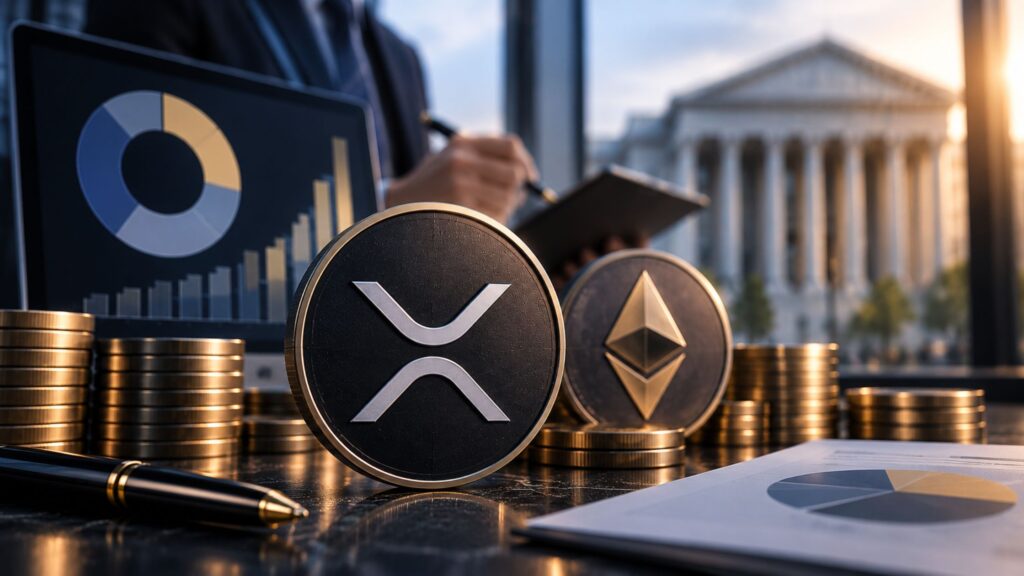
Grayscale has added another institutional angle by launching its Digital Assets Next Gen model portfolio for financial advisors. According to the reported allocation, XRP represents 26% of the portfolio, while Ether accounts for 42%.
The allocation places XRP among the portfolio’s holdings and provides another example of institutional products incorporating the asset.
How the Developments Connect
XRP institutional interest grows across channels, including investment products, regulatory developments, and network utility. Regulation can influence access, while ETFs and model portfolios provide structured exposure.
At the same time, XRPL activity and RLUSD offer examples of blockchain usage. Yet the central issue remains whether increased adoption of the network translates into sustained demand for the XRP token itself.
Recent performance adds context in crypto markets. XRP was reported to be up 42.6% over 30 days, compared with a 24.4% gain for Bitcoin during the same period. Short-term performance, however, can shift quickly in crypto markets. Investors should distinguish reported developments from assumptions about future market behavior and valuations.
Conclusion
XRP institutional interest grows today while the price remains subdued. XRP institutional interest grows through multiple channels. The developments involving 21Shares, Ripple, and Grayscale point to expanding institutional access, network activity, and financial use cases.
Still, these developments should be viewed separately from assumptions about future price performance. The key question remains whether institutional participation and XRPL adoption ultimately create sustained demand for XRP. For now, the asset’s market activity and ecosystem developments remain areas to watch.