
XRP Auto Bridging Explained highlights an established feature of the XRP Ledger that could connect thousands of digital assets without requiring a separate market for every token pair. With 1,000 tokens, just 1,000 XRP-linked markets could theoretically support routes between 499,500 combinations. This crypto infrastructure offers an alternative to fragmented trading, although available liquidity ultimately determines whether a swap is practical.
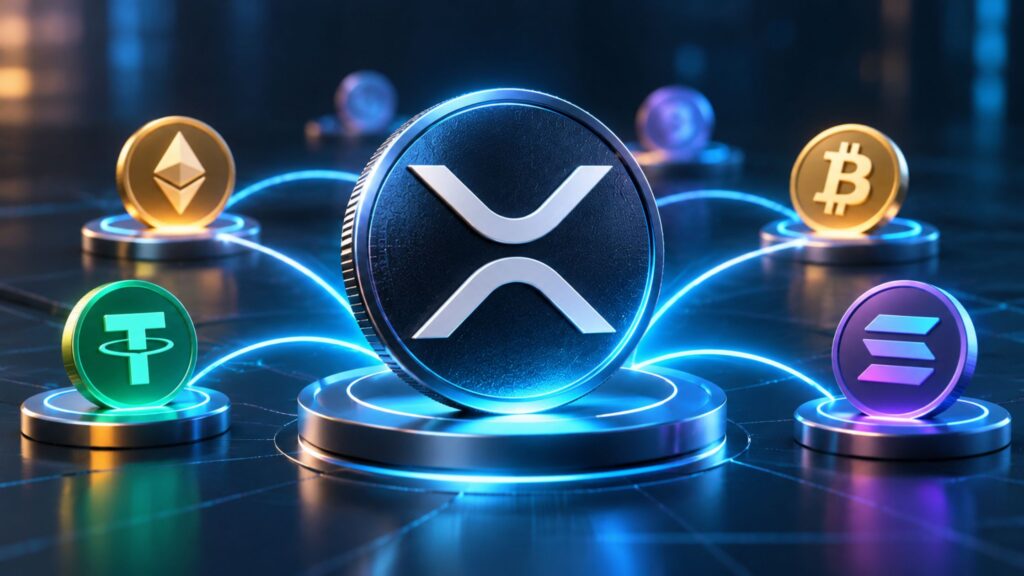
How XRP Connects Different Markets
Traditional token exchanges depend on trading pairs. If every asset needed a direct market against every other asset, the number of markets would expand rapidly. For 1,000 assets, the calculation is 1,000 multiplied by 999, divided by two, producing 499,500 possible pairs.
The XRP Ledger offers another arrangement. Each token can trade against XRP, which acts as an intermediary. Rather than maintain hundreds of thousands of direct pairs, market makers could provide liquidity across 1,000 XRP markets.
Think of a transportation hub connecting cities without direct flights. A trader seeking one asset can potentially pass through XRP to reach another. The route creates connectivity, not guaranteed execution or favorable prices.
Auto Bridging Is Already Available
Unlike a proposed upgrade, auto bridging already operates within the XRP Ledger’s decentralized exchange. According to official XRPL documentation, the system can combine direct offers with XRP-mediated offers when doing so improves the effective exchange rate.
XRP Auto Bridging Explained is therefore about existing functionality, not a newly announced launch. Traders submitting exchange orders do not need to activate a separate bridging setting. However, ordinary payments use different pathfinding mechanics and should not be confused with exchange auto bridging.
This distinction matters for crypto users assessing claims about new network capabilities. Better connectivity can make markets more accessible, but it cannot manufacture liquidity.
Stablecoin Swaps Show the Possibilities
Consider a holder exchanging RLUSD for EURØP. An available route might move through RLUSD, XRP and then EURØP. Another trader swapping USDC for RLUSD could similarly use XRP between the two stablecoins.
Whether either path is selected depends on order availability and pricing. Auto bridging can combine liquidity from connected markets, but the weaker side of the route may limit its depth. Slippage and fees also influence the final amount received.
XRPL.to described a November 23 example in which 100 RLUSD could purchase approximately 1,891,688 FUZZY through an XRP route, with reported price impact of 0.55%. That quote illustrates a particular market snapshot, not a permanent exchange rate.
For the broader crypto economy, the attraction is efficient access to assets across different issuers and markets.
XRP Price and Trading Activity
XRP Auto Bridging Explained also arrives alongside a modest market recovery. The supplied CoinMarketCap snapshot showed XRP at $0.9321, gaining 1.6% over 24 hours. Market capitalization stood near $59.2 billion, while daily trading volume fell 47.24% to approximately $1.33 billion.
Lower volume can signal reduced participation, even as prices rise. These figures do not establish that interest in auto bridging drove XRP’s advance. Infrastructure utility and short-term crypto price action require separate analysis.
What This Means for Investors
A common intermediary reduces the number of markets theoretically needed to connect many tokens. Yet accessible routes are not equivalent to liquid markets, and trading quality still depends on spreads, depth and execution conditions.
For crypto developers, the model may simplify market integration. For traders, it broadens potential paths without removing market risk.
Conclusion
XRP Auto Bridging Explained demonstrates how 1,000 markets could theoretically connect 499,500 token pairs. The mechanism is operational, but its usefulness depends on real orders and adequate liquidity. Investors should distinguish this established crypto feature from price forecasts or promises of immediate adoption.