
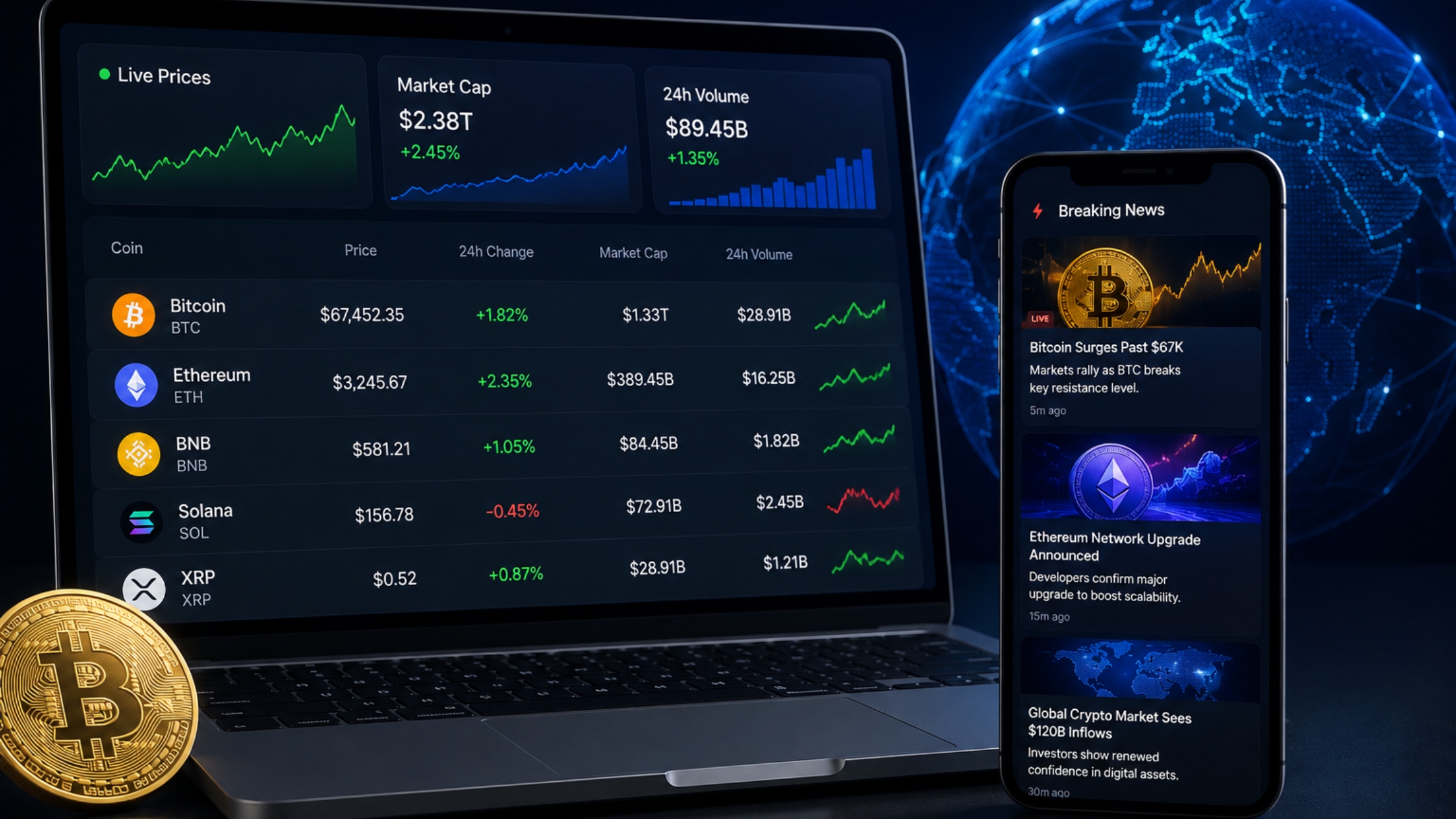
The cryptocurrency market operates 24 hours a day, making real-time data essential for anyone following digital assets. Prices, trading volume, market capitalization, and Bitcoin dominance can change quickly as market conditions develop.
Unlike traditional stock markets, crypto has no single daily closing session. As a result, yesterday’s price or even a figure from earlier in the day may already be outdated. A reliable cryptocurrency tracker combines live prices with market data and relevant news so readers can understand what is happening across the broader market.
Crypto Market Cap at a Glance
Current market trackers place total cryptocurrency market capitalization around 2.2–2.3 trillion in August 2026. Bitcoin accounts for approximately 56-58% of the market, while Ethereum represents roughly 10%.
These figures are snapshots. Market capitalization changes constantly based on asset prices, circulating supply, and data provider methodology.
Key metrics to monitor include:
- Total crypto market capitalization
- 24-hour trading volume
- Bitcoin market capitalization
- Bitcoin dominance
- Ethereum market capitalization
- Individual cryptocurrency prices
- Circulating supply and token unlocks
For the most accurate information, always check the timestamp and source behind the displayed figures.
What Is Cryptocurrency Market Cap?
Crypto market capitalization is calculated by multiplying an asset’s current price by its circulating supply. It helps investors compare the relative size of different cryptocurrencies.
However, market cap does not represent the amount of money invested in an asset or the amount of liquidity available for trading.
For example, a cryptocurrency priced at $0.01 is not necessarily cheaper than one priced at $100. The total supply must also be considered. Therefore, price, market cap, supply, volume, and liquidity should be evaluated together.
What Moves Crypto Prices Today?
Several factors can influence cryptocurrency prices, including breaking news.
Regulation and policy can influence exchanges, stablecoins, projects, and overall market expectations.
Stablecoin activity provides insights into crypto liquidity, settlement, and market demand.
Bitcoin positioning affects markets through transactions, derivatives, macroeconomic events, and sentiment.
Altcoin rotation shifts capital across sectors, often increasing smaller asset risks.
How to Read Live Crypto Charts
A live cryptocurrency chart becomes more useful when each metric answers a specific question:
- Price: What is the asset trading at now?
- 24-hour change: How significantly has the price moved?
- Market cap: How large is the asset relative to others?
- Volume: Is there meaningful trading activity behind the move?
- Circulating supply: How many tokens are currently available?
These metrics provide a useful starting point, but they do not replace research into token economics, security, custody, liquidity, or project fundamentals.
Bitcoin Dominance and Stablecoins
Bitcoin dominance measures Bitcoin’s share of the total cryptocurrency market capitalization. A rising percentage can indicate that Bitcoin is outperforming other crypto assets, while falling dominance may suggest greater activity in altcoins.
However, Bitcoin dominance should not be treated as a standalone trading signal. Volume, volatility, liquidity, macroeconomic conditions, and cryptocurrency news should also be considered.
Stablecoins are equally important because they connect trading, on-chain settlement, and some payment activity. Their supply and usage can provide market context, although stablecoins also carry issuer, redemption, custody, regulatory, and depegging risks.
Conclusion
Following cryptocurrency today requires more than checking a list of coin prices. Market capitalization, trading volume, Bitcoin dominance, circulating supply, stablecoin activity, and breaking news all provide valuable context.
A live crypto dashboard can make this information easier to follow, but no single metric can predict where prices will move next. By checking current data, timestamps, sources, liquidity, and market conditions, readers can develop a more informed view of the rapidly changing cryptocurrency market.