

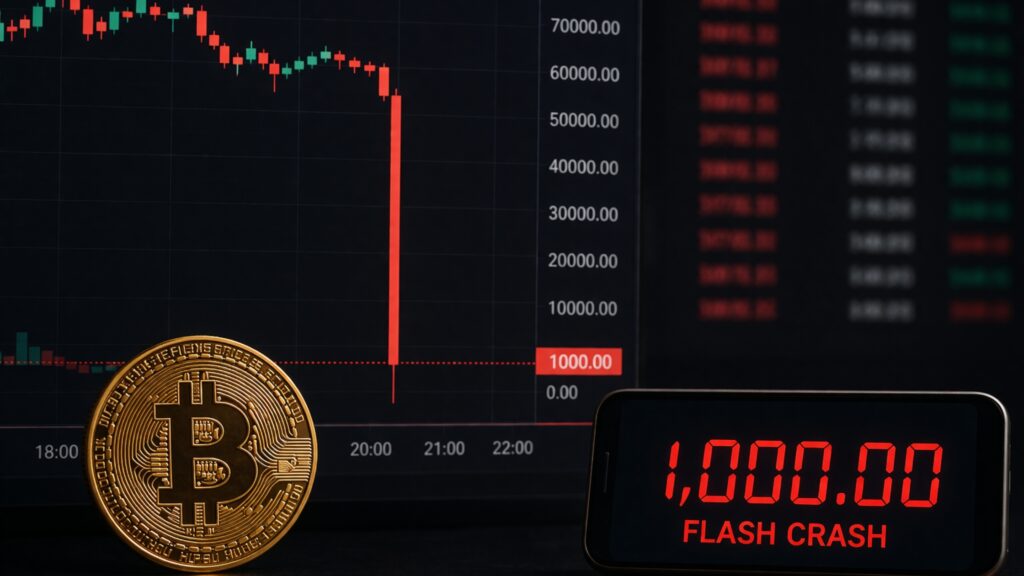
This morning, Bitcoin traders were greeted with a shocking sight on a prominent European cryptocurrency exchange: the price of Bitcoin appeared to crash from around $68,000 to an astonishing $1,000 in a matter of minutes. The unexpected event caused a frenzy, with social media flooded with screenshots and reactions from traders rushing to take advantage of the drastic price drop, hoping to buy at a significant discount.
Was This a Real Market Event?
Bitcoin’s price plummeted by 99.9% triggered fears of a catastrophic failure, with many speculating a fat-finger trade. Traders were alarmed, but it was an elaborate April Fools’ prank. The exchange modified its front-end display to show Bitcoin at $1,000, referencing early 2013 prices.
This playful gesture aimed to spark nostalgia within the crypto community. No real liquidations or trades occurred at this level, and prices on major platforms like Coinbase and Binance remained steady.
What Was the Flash Crash?
A flash crash is a genuine market phenomenon where a lack of buy orders (or liquidity) leads to a rapid and temporary collapse in prices. Flash crashes can occur for several reasons, including:
- High-frequency trading (HFT) algorithm errors – Malfunctions or miscalculations in algorithmic trading systems.
- Massive sell orders – Large sell orders are hitting “thin” order books that can’t absorb the volume.
- Technical glitches – Problems within an exchange’s matching engine or backend systems.
Although today’s Bitcoin price “crash” was a joke, real flash crashes have had disastrous effects. Fortunately, Bitcoin’s price remained stable on major platforms, confirming the “crash” was localized.
The Reality of the Current Market
While the Bitcoin “flash crash” was a humorous April Fools’ prank, the actual cryptocurrency market remains far from stable. Bitcoin has been navigating “macro jitters,” with prices hovering around $69,000 as investors weigh global geopolitical tensions, inflationary pressures, and interest rate decisions. Despite the prank, the market’s current situation shows a period of consolidation and caution.
Why the Joke Hit So Hard
The choice of $1,000 as the target price for Bitcoin was not random. This figure represents a psychological “holy grail” for many latecomers to the crypto space. At a price level that hasn’t been seen since 2013, the $1,000 target taps into the Fear of Missing Out (FOMO) phenomenon that drives much of retail trading activity.
“I almost threw my coffee at the monitor,” one trader shared. “I knew it was April 1st, but seeing that red candle touch $1,000 makes your survival instincts kick in before your brain does.”

Protecting Your Portfolio from Real Volatility
Although today’s price flash crash was a joke, it highlights the real volatility in cryptocurrency markets. While exchanges are improving their systems, risks remain with keeping assets on centralized exchanges. Experts recommend:
- Cold storage: Using hardware wallets to store assets offline, minimizing exposure to potential exchange errors or hacks.
- Diversified order books: Spreading trades across multiple high-volume exchanges improves price discovery and reduces the chances of anomalies.
- Regular portfolio monitoring: Continuously monitoring your portfolio and using automated alerts can help mitigate risks during sudden market shifts.
While today’s event was harmless, it underscores the importance of risk management strategies in crypto trading.
Conclusion
While the Bitcoin flash crash on a European exchange was a well-executed April Fools’ prank, it also highlighted the volatility that still exists in cryptocurrency markets. Despite this humorous event, the broader crypto market remains uncertain, with investors watching geopolitical tensions and economic data closely. As always, it’s essential to approach crypto investments with caution, understanding both the opportunities and risks involved.