
Bitcoin is once again being tested during a major global crisis. Many supporters often call it “digital gold” because they believe it can act as a safe-haven asset when fear rises in traditional markets. However, the current Hormuz crisis is making that argument harder to defend.
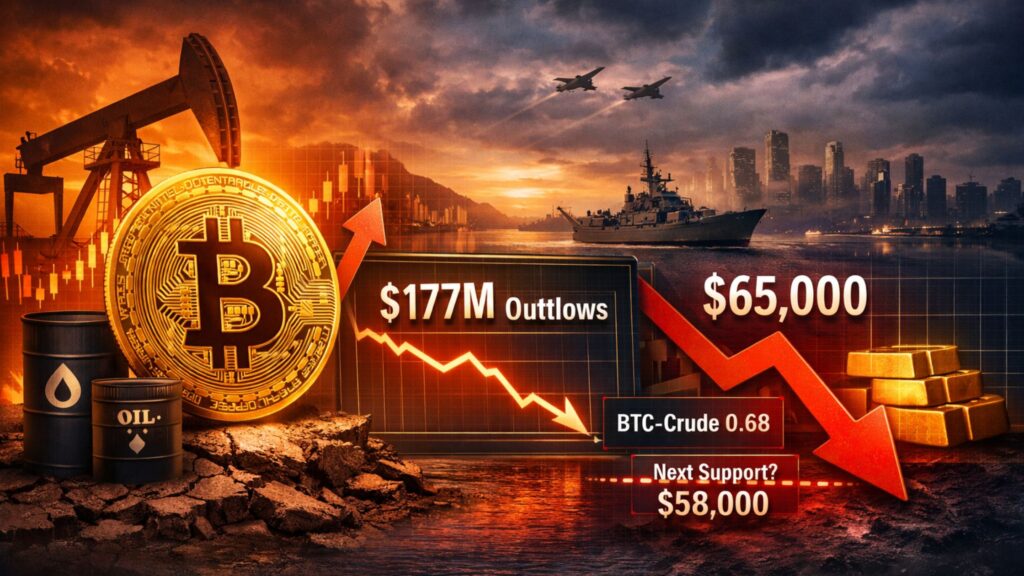
Instead of clearly moving away from risk assets, Bitcoin has recently been trading more like one. Reports tied to this market move say Bitcoin’s correlation with WTI crude has climbed to 0.68, which is much higher than the lower historical range often seen in calmer periods. That means Bitcoin and oil have been moving more closely together than many investors would expect.
Rising Oil Prices Are Changing the Market Mood
The Strait of Hormuz remains one of the most important energy routes in the world. Reuters reported that Iran’s disruption of traffic through the strait has affected a route that normally handles around 20% of global oil and gas shipments.
As a result, oil prices moved sharply higher. Reuters reported that Goldman Sachs raised its near-term outlook and now expects Brent crude to average $110 in March and April 2026 under a severe disruption scenario. Goldman also said longer disruption risk could keep the market tight and highly sensitive to supply news.
This matters for Bitcoin because higher oil prices can keep inflation elevated. When inflation stays sticky, central banks have less room to cut rates or support liquidity. That creates pressure for assets that tend to perform better when money is easier to access. In this environment, Bitcoin may behave more like a risk-sensitive asset than a defensive one. That link between macro pressure and crypto weakness is an inference supported by the oil outlook and broader analyst caution on Bitcoin.
Why Bitcoin Is Not Fully Acting Like “Digital Gold”
In past periods of uncertainty, some investors expected Bitcoin to rise alongside gold or move independently from commodities like oil. Right now, that clean decoupling is not happening.
The Yahoo Finance report argues that Bitcoin is failing its biggest safe-haven test of 2026 because it is responding more to liquidity fears than to geopolitical fear itself. In simple terms, traders are worrying less about war headlines alone and more about what higher energy prices could do to inflation, interest rates, and financial conditions.
That helps explain why Bitcoin has not delivered the clear safe-haven response many expected. Even though the “digital gold” story remains popular, price action still shows that Bitcoin is sensitive to the same macro forces that affect other risk assets.
Key Levels Traders Are Watching
The market is now focused on whether Bitcoin can defend an important support zone near $65,000. According to the Yahoo Finance report, losing that area could raise the chance of a deeper move toward $58,000.
On the other hand, the bearish case may weaken if Bitcoin can reclaim roughly $72,000 while oil remains above $100. That kind of move would suggest Bitcoin is starting to separate from energy-driven macro pressure and rebuild its independent strength. For now, though, the market still appears cautious.
There is one supportive sign beneath the surface. The report says larger wallets holding 1,000 to 10,000 BTC have continued accumulating in the $65,000 to $70,000 range. It also points to a recent Morgan Stanley ETF-related filing as a sign that institutional infrastructure continues to develop even during this volatile period. That suggests some bigger players may still believe the current macro shock is temporary.

Final Thoughts
The Bitcoin safe haven narrative is under pressure right now. Oil prices have surged because of the Hormuz crisis, and Bitcoin has not clearly decoupled from the broader risk environment. Instead, stronger correlation with crude and concern over tighter financial conditions are shaping price action.
That does not mean the long-term case for Bitcoin is broken. It does mean that, in this moment, Bitcoin is not behaving like pure digital gold. Until the market sees lower oil pressure or stronger Bitcoin price recovery above key resistance, traders are likely to remain careful.